In a day of mixed signals, Asian markets largely saw gains on Tuesday, buoyed by the positive momentum from Wall Street's technology sector. While most indices in the region showed improvement, Hong Kong and Shanghai remained relatively flat or slightly down. The Nikkei 225 surged, reflecting broader investor confidence in tech stocks, particularly those involved in artificial intelligence. Meanwhile, U.S. markets continued to recover from their holiday-season slump, with tech companies leading the charge. However, concerns over potential policy shifts under the incoming administration added an element of caution. Notably, Nippon Steel faced challenges as its proposed acquisition of U.S. Steel was contested, while Nvidia’s stock reached new heights ahead of a major industry event.
Nikkei Soars as Tech Stocks Drive Market Gains
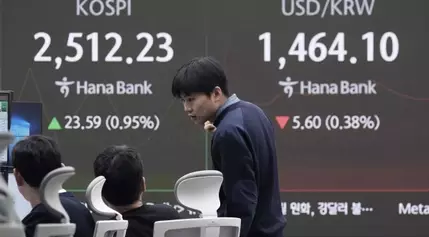
In the early hours of a crisp autumn morning, Tokyo's financial district buzzed with activity as the Nikkei 225 index climbed 2.4% to reach 40,248.68. This surge was mirrored across other parts of Asia, with Australia's S&P/ASX 200 inching up 0.3% to 8,279.30, and South Korea's Kospi gaining nearly 1.0% to settle at 2,513.39. In contrast, Hong Kong's Hang Seng dipped slightly, dropping 0.3% to 19,635.67, while China's Shanghai Composite remained virtually unchanged, slipping less than 0.1% to 3,205.55.
The optimism in Asian markets was fueled by the robust performance of technology stocks on Wall Street, especially those associated with artificial intelligence (AI). Nvidia, a leader in AI development, saw its stock climb 3.4%, surpassing its previous record set in November. Investors were eagerly anticipating CEO Jensen Huang's speech at the CES convention in Las Vegas, which promised further insights into the company's innovative advancements.
However, not all sectors shared in the market's enthusiasm. Nippon Steel, a Japanese steel giant, saw its shares slide 1.5% in Tokyo trading. This decline came after the company's CEO reaffirmed its commitment to acquiring U.S. Steel, despite the Biden administration's opposition to the nearly billion deal. The two companies had filed a lawsuit challenging President Joe Biden's decision to block the merger, arguing that it lacked substantial evidence of posing any security risks to the United States.
In the U.S., markets also reflected a mix of optimism and caution. The S&P 500 gained 0.6%, marking its second consecutive day of positive returns following a prolonged losing streak. The Nasdaq composite rose 1.2%, driven by strong performances from tech companies. However, the Dow Jones Industrial Average slipped marginally, losing 0.1%. Investors were closely monitoring potential policy changes under the incoming administration, which could have far-reaching implications for the economy and financial markets.
The week ahead promises several key events that could influence market sentiment. The Federal Reserve is set to release minutes from its last policy meeting, where it cut interest rates for the third consecutive time. Additionally, the monthly jobs report and consumer sentiment update are scheduled for Friday, providing crucial insights into the health of the U.S. economy. Concerns about inflation and tariffs also loomed large, with long-term Treasury yields climbing in response to worries about sustained higher interest rates.
In the energy sector, benchmark U.S. crude oil prices declined slightly, settling at .23 per barrel, while Brent crude fell to .02 per barrel. Currency markets saw the U.S. dollar strengthen against the Japanese yen, rising to 158.29 yen from 157.58 yen. The euro, meanwhile, weakened slightly to .0381 from .0392.
The New York Stock Exchange and Nasdaq will close on Thursday in observance of a National Day of Mourning for former President Jimmy Carter, adding another layer of uncertainty to the trading week.
From a journalistic perspective, this convergence of economic indicators and policy uncertainties highlights the delicate balance traders must navigate. As markets respond to both positive corporate news and potential policy shifts, investors will need to remain vigilant and adaptable. The coming weeks will likely reveal whether the current optimism can withstand the challenges posed by geopolitical tensions and economic volatility. For now, the resilience of tech stocks offers a glimmer of hope in an otherwise uncertain landscape.
New